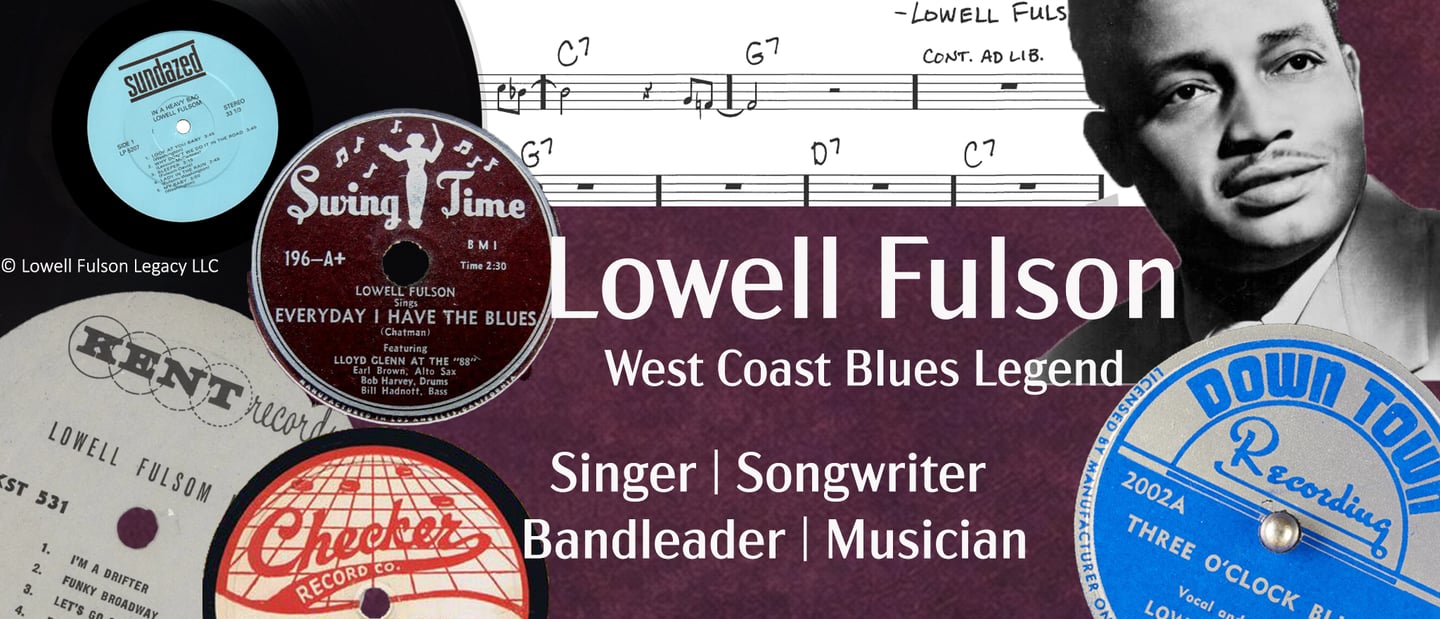
The Lowell Fulson Story
Long before the worlds of blues, rhythm & blues, rock & roll, soul, and hip-hop were divided into genres, Lowell Fulson was creating music that would help shape them all.
Born in Tulsa, Oklahoma, on March 31, 1921, and raised in nearby Ada, Fulson grew up surrounded by music. His grandfather played violin, his uncles played guitar, and family gatherings often included songs that blended church traditions, folk music, and the blues. By his early teens, he was already performing at picnics, dances, and community gatherings throughout Oklahoma.
As a teenager, Fulson spent time traveling and performing with legendary blues singer Texas Alexander, an experience that exposed him to the realities of life as a working musician and helped shape his distinctive approach to songwriting and performance.
After serving in the United States Navy during World War II, Fulson relocated to Oakland, California, where he became one of the pioneering voices of what would later become known as West Coast Blues. While many blues artists remained rooted in rural traditions, Fulson embraced innovation. His music combined the emotional depth of country blues with the sophistication of jazz, swing, and urban rhythm & blues, helping to create a sound that was both modern and unmistakably his own.
His breakthrough recordings quickly established him as one of the most important artists of his generation. Songs such as "Three O'Clock Blues," "Every Day I Have The Blues," "Blue Shadows," and "Lonesome Christmas" became rhythm & blues hits and laid the foundation for countless artists who followed. B.B. King's first No. 1 hit was his recording of Fulson's "Three O'Clock Blues," and King openly acknowledged Fulson as one of his greatest influences.
In 1954, Fulson recorded "Reconsider Baby," a song that would become one of the most enduring standards in blues history. Over the decades it has been recorded by artists including Elvis Presley, Eric Clapton, Ike & Tina Turner, Gregg Allman, and many others. In 2004, James Henke, chief curator for the Rock and Roll Hall of Fame, with the help of music writers and critics, included “Reconsider Baby” in a selection of 500 songs (not only rock songs) that they believe have been most influential in shaping rock and roll.
Unlike many of his contemporaries, Fulson never stopped evolving. In 1967, he released "Tramp," a groundbreaking record that crossed stylistic boundaries and became a hit once again when recorded by Otis Redding and Carla Thomas. Decades later, the same recording would find new life through sampling, appearing in music by artists including Salt-N-Pepa, Ice Cube, Prince, Redman, Cypress Hill, Wu-Tang Clan, and many others.
Throughout a career that spanned more than fifty years, Fulson remained a songwriter, bandleader, performer, and mentor. His bands helped develop younger musicians, including a young Ray Charles, who toured with Fulson early in his career before becoming one of the most influential artists in American music.
Yet despite his influence on multiple generations of artists, Lowell Fulson's name is often less recognized than the musicians he inspired.
That reality is beginning to change.
Today, Lowell Fulson's legacy is being preserved and celebrated by his family through Lowell Fulson Legacy LLC, the official steward of his life, music, and intellectual property. Through archival preservation, rights management, educational initiatives, and new opportunities for discovery, the organization is committed to ensuring that future generations understand the extraordinary role Fulson played in shaping American music.
His story is not just the story of a blues musician.
It is the story of an innovator whose influence continues to echo across blues, rhythm & blues, soul, rock, and hip-hop more than seventy years after he first stepped into a recording studio.
Official website of Lowell Fulson Legacy LLC. Preserving the music, protecting the legacy, and celebrating the enduring influence of Lowell Fulson.